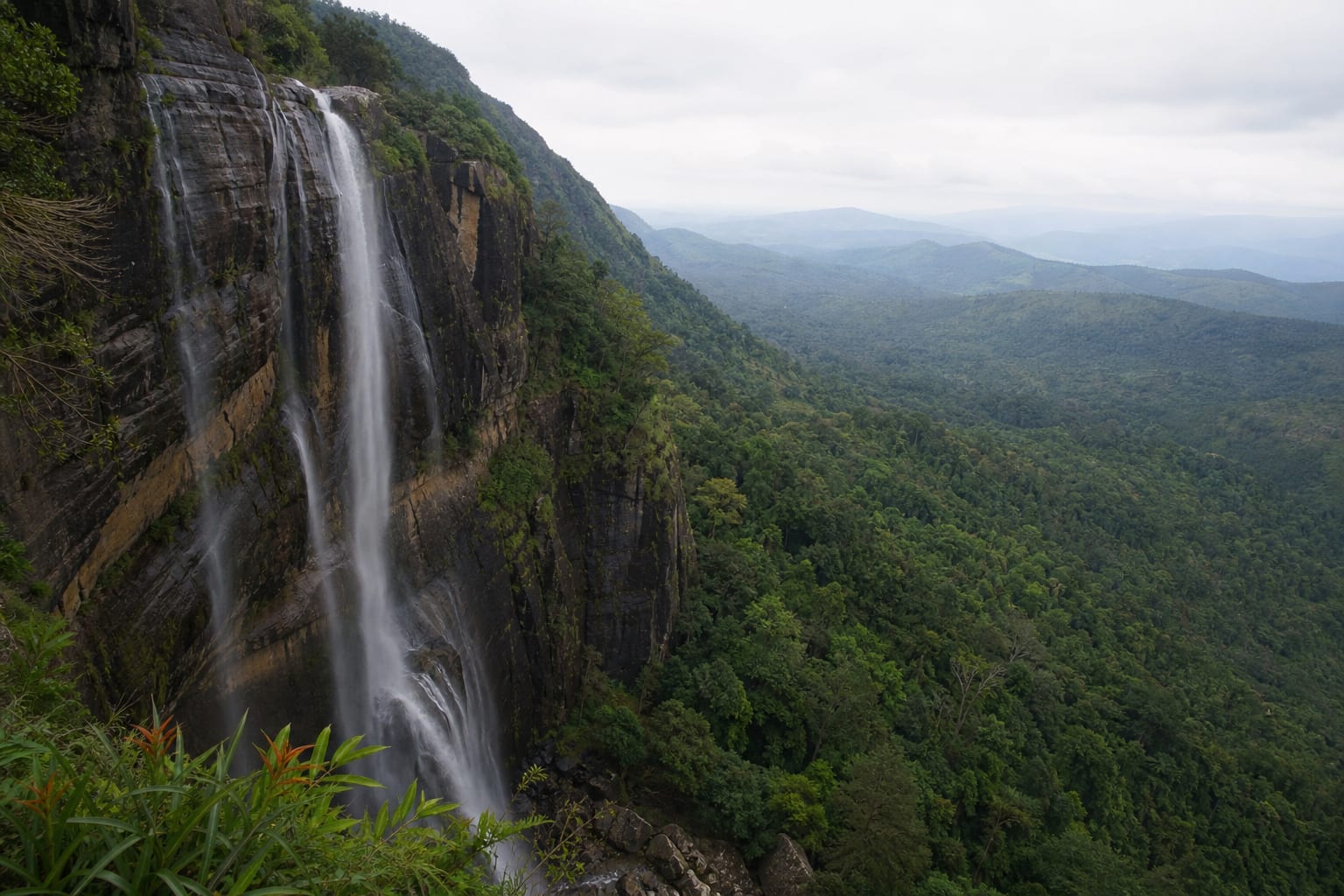
Diyaluma Falls is the roadside view everyone photographs. The natural pools on the ridge above it are the reason to actually stop.
There are two versions of Diyaluma Falls and most people only see the first one. From the Wellawaya road you get the postcard: a long white drop off a rock face, best viewed from a pull-in where a few vendors sell king coconut and somebody offers to watch your car.
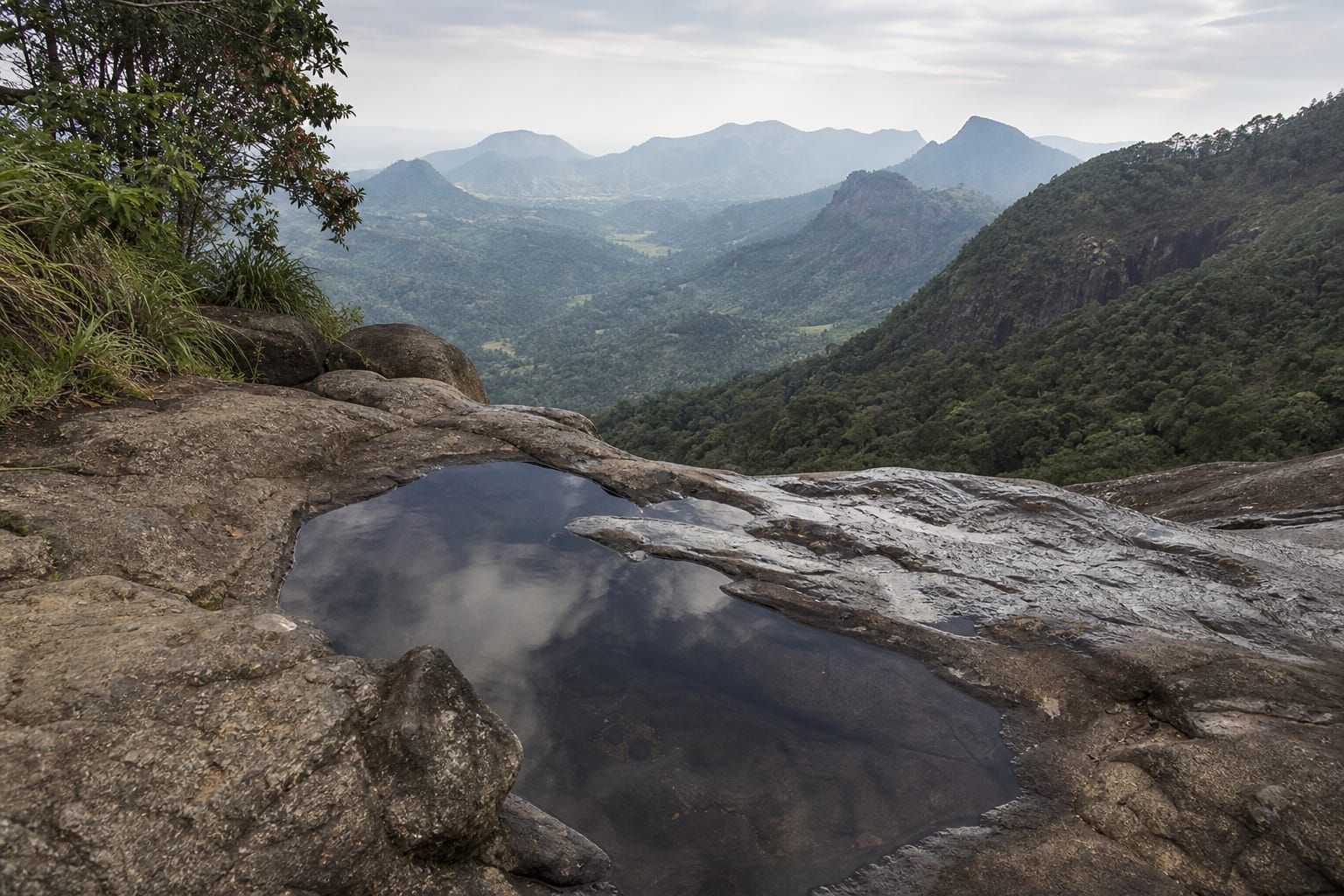
The second version is on top. A series of pools sit in the rock at the head of the falls, filled by the stream before it goes over the edge, and you can swim in them with the whole Koslanda valley opening up below. That is the reason to build a morning around this place rather than a ten-minute stop.
Getting up there is straightforward if you know where the path starts and genuinely confusing if you don't.
Where is Diyaluma Falls?
It is on the Koslanda to Wellawaya road in Uva Province, in the band of country between Ella and the dry lowlands to the south. Ella is the usual base — most people come across for the morning and go back the same day.
At roughly 220 metres it is one of the tallest falls in Sri Lanka, which is the statistic every page repeats. More useful: the landscape changes character around here. You are dropping off the wet highlands toward the dry zone, and the heat at the bottom of the falls is noticeably different from the air in Ella.
TODO: put your own travel time and transport cost from Ella here — bus, tuk-tuk or hired car, whichever you actually used, and what it cost this season. That is the detail every other guide fudges.
How do you get to the upper pools?
The path does not start at the roadside viewpoint. It starts further up the road, near the village of Poonagala side of the falls, and climbs through scrub and rubber before cutting across to the top of the drop.
The walk is not long — most people put it around half an hour to forty minutes up — but it is steep in stretches and the ground is loose in the dry months and slick in the wet ones. There is no signage worth relying on and several informal paths braid together near the top.
TODO: describe the actual turn-off you used, and how you knew it. A single sentence naming the landmark you turned at is worth more to a reader than everything else in this section.
Local guides wait near the start and will take you up for a fee. Whether that is necessary depends on conditions and on how comfortable you are following an unmarked path. In the wet season it is a reasonable thing to pay for.
Can you swim at Diyaluma?
In the upper pools, yes, and it is the whole point of the walk. They are cold, clear and deep enough to properly get in, and there are several of them at different levels so you can usually find one to yourself even when the top one is busy.
At the base of the falls the answer is more cautious. The plunge pool takes the full force of the water and the flow changes fast when it has rained higher up the catchment. It is not the swim people imagine from the road.
The water level dictates everything here. After heavy rain the pools are dangerous rather than inviting; in the driest stretch of the year some of them are barely knee-deep. There is a window in between where it is very good.
TODO: name the months you have found best, based on when you have actually been. Contradicting the generic advice with real observation is exactly what makes this page worth reading.
When is the best time to go?
Mornings, without much argument. The light into the valley is better, the rock has not had all day in the sun, and you avoid both the afternoon cloud that builds over the highlands and the tour vans that arrive after lunch.
Seasonally, this side of the island is driest roughly from May through September, which is the inverse of the west coast. That catches people out constantly.
Is Diyaluma worth it compared to Ravana Falls?
Not a close contest. Ravana Falls, on the Ella side, is visible from the road and that is more or less its entire proposition — a ten-minute stop with monkeys and vendors and no reason to linger.
Diyaluma asks for a morning and a walk, and gives you somewhere to swim with a view most people never see. If you have one waterfall day in the hill country, spend it here.
The wider set of falls across this part of the island is covered in our roundup of waterfall guides — several of them need a village guide rather than a car park, and are quieter again than this one.
What to bring
- Shoes with grip. The climb is loose underfoot both wet and dry, and flip-flops are how people get hurt on the descent.
- More water than you expect. There is nothing to buy once you are up.
- A dry bag if you are carrying a camera or a phone you care about.
- Cash, in small notes, for the guide or the parking if you use them.
Go up early, swim in the second or third pool rather than the first, and give yourself longer at the top than the walk seems to warrant. Coming back down in the afternoon heat is the least pleasant part of the day, so plan to be finished before it.