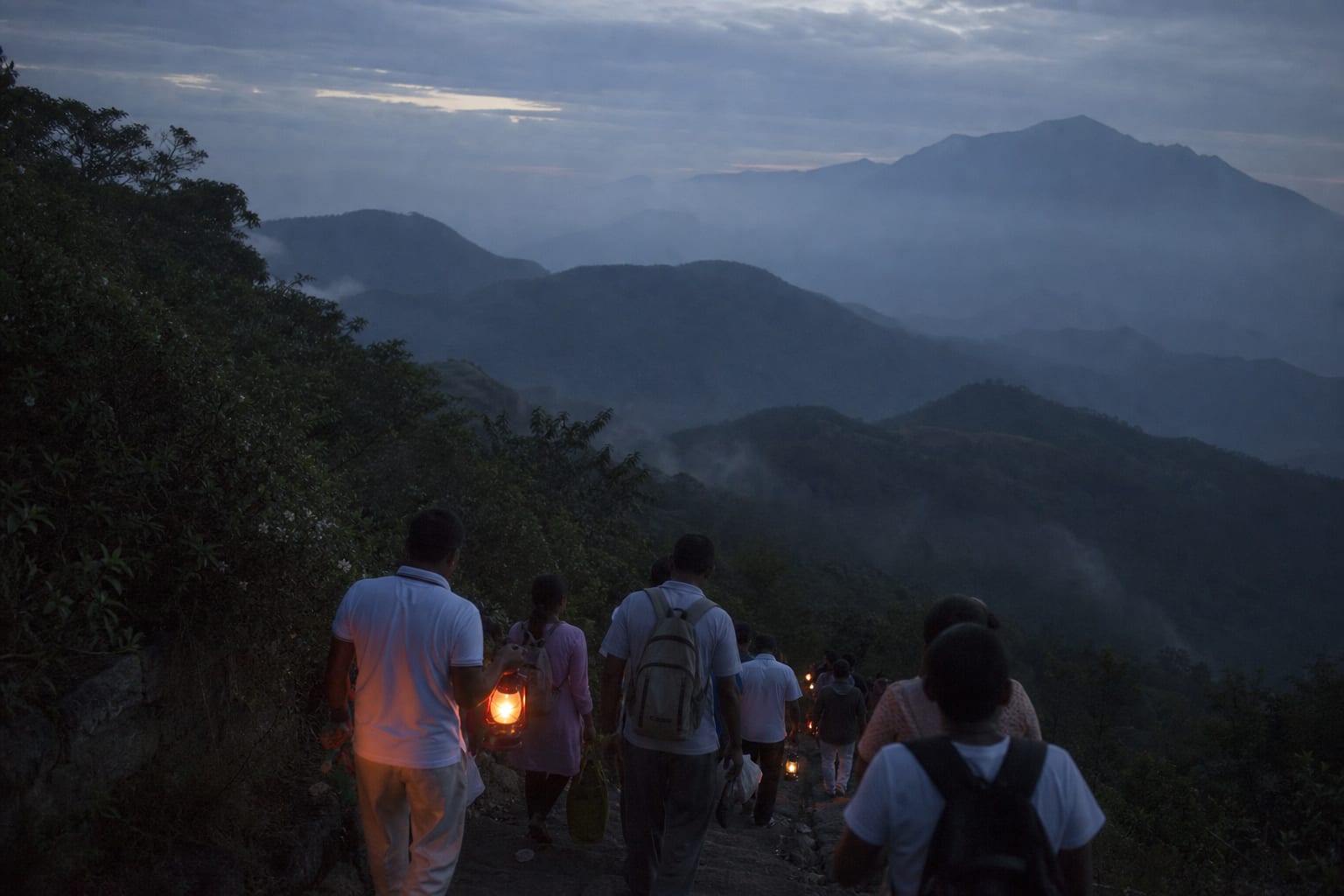
Climbing Adam's Peak outside pilgrimage season means no lights, no tea shops and a closed summit temple. Here is the season that matters.
Most of what gets written about Adam's Peak treats it as a sunrise hike with a lot of steps. It is that, but the framing misses why the mountain works at all, and it leads people to climb at the wrong time of year and wonder why the experience felt hollow.
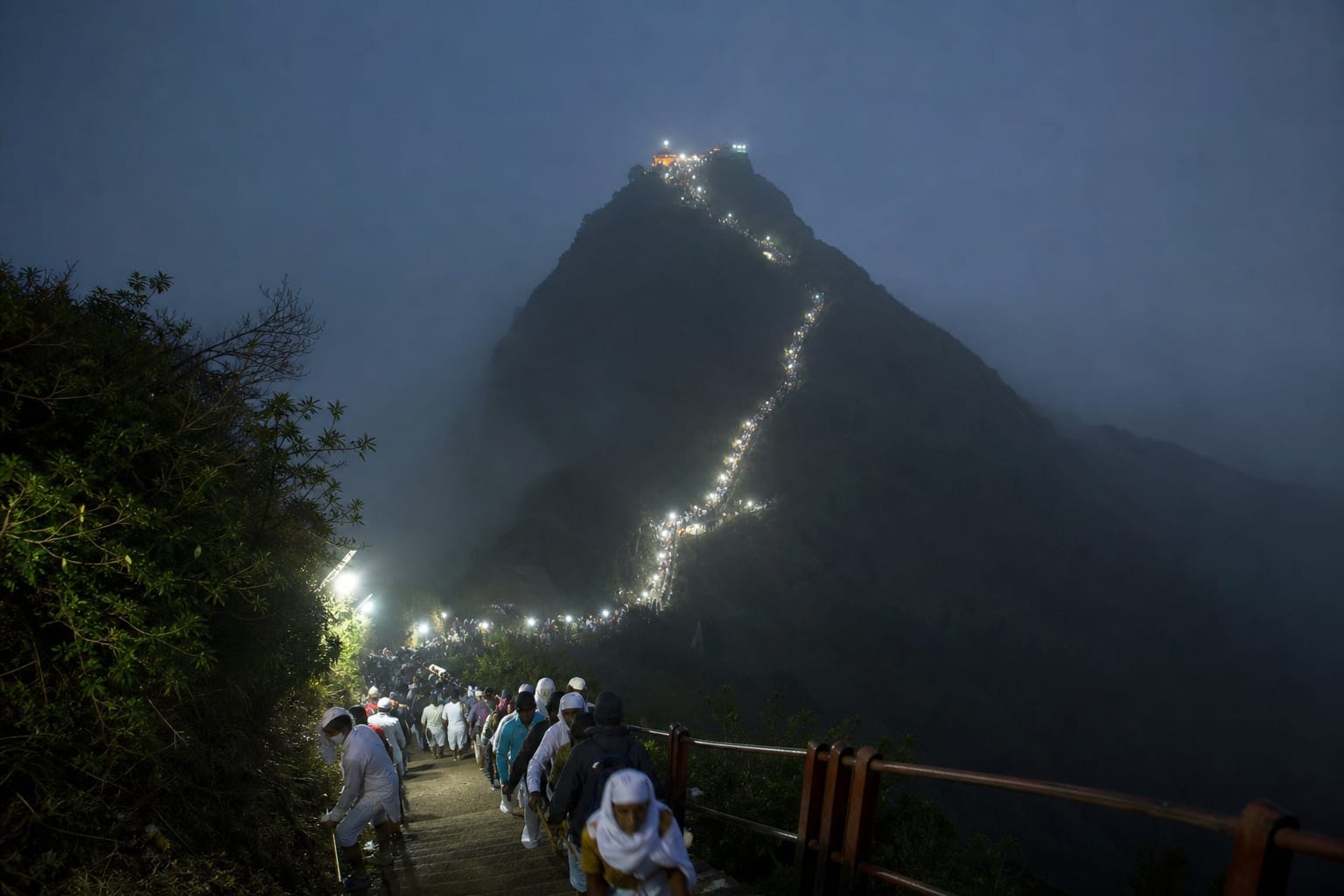
Sri Pada — the sacred footprint — is a pilgrimage site, and it has been one for well over a thousand years. Buddhists, Hindus, Muslims and Christians all attribute the mark at the summit differently, and all four traditions climb it. The thing that makes the night ascent extraordinary is not the staircase. It is being on it at two in the morning with several thousand people of all ages, including grandmothers doing it barefoot, moving slowly upward under a line of lights that goes further up the dark than seems reasonable.
Climb outside the season and you get the staircase without any of that.
When is Adam's Peak season?
The pilgrimage season runs from the Unduwap Poya full moon in December to the Vesak Poya full moon in May. That is the window when the mountain functions as intended:
- The staircase lights are on the whole way up.
- The tea shops and rest points along the route are open through the night.
- The summit temple is open and the rituals — including the bell — are happening.
- There are thousands of other people on the mountain, which is the point rather than a drawback.
Outside that window, from roughly June to November, the lights are switched off, the summit temple is closed, most of the shops along the route shut, and the path is wet and slippery. The footprint that is the entire reason for the climb is not accessible.
You can physically walk up in August. There is not much reason to.
Which trail should you take?
Two main routes, and the choice matters more than people expect.
Hatton / Nallathanni is the shorter and much more used route, and it is what almost every visitor takes. Steeper, but far fewer total steps and better served with transport, accommodation and food at the base. If nobody has told you otherwise, this is your route.
Ratnapura / Palabaddala is the traditional pilgrimage approach — considerably longer, harder, and quieter, taking roughly twice as long. Pilgrims who want the full merit of the climb take this one. It is a serious undertaking and not the route to pick for a first attempt.
The step count you will see quoted — around 5,500 — refers to the Hatton side.
What time should you start?
The standard is to start around one or two in the morning from Nallathanni, reaching the summit before dawn. The climb takes most people somewhere between two and a half and four hours depending on fitness and, more decisively, on the queue.
On a busy Poya weekend the crowd itself sets your pace, and the last stretch can crawl. Starting earlier on those nights is not overcautious.
TODO: add your own start time, how long it took you, and which night of the week you went. Timing advice from someone who actually climbed on a specific date is far more useful than a range.
What to expect at the summit
The sunrise is the photograph, and on a clear morning there is a second thing worth turning around for: the mountain casts a perfect triangular shadow onto the cloud and haze to the west, which lasts a few minutes and is stranger than any picture of it suggests.
The summit temple area is small and, in season, extremely crowded. This is an active place of worship rather than a viewpoint.
Is it a hard climb?
Physically it is straightforward but relentless — an unbroken staircase for hours, which is a specific kind of tiring that a normal hike is not. The difficulty is monotony and cumulative load rather than technical ground.
People of every age and fitness level do it, and many take it in stages, resting at the tea shops along the route. That is entirely normal and there is no reason to push through.
The descent is harder on the knees than the climb is on the lungs. Poles help if you have them.
Current access
Access to protected areas across the central highlands was disrupted by Cyclone Ditwah in late November 2025, with landslide damage affecting the Peak Wilderness Sanctuary among others, and advisories were issued against climbing. Recovery has been running through 2026 and the position has been changing.
Check the current status before you plan a trip around this — with the temple authorities, a local operator, or your accommodation at Hatton or Nallathanni. TODO: confirm and date this section before publishing.
For other hill country walks that are less dependent on season, see our guides to Horton Plains and the Ella Rock hike.
Go in season or don't go. If you do go, start earlier than you think you need to, carry a warm layer, and spend the first few minutes at the top watching the people around you rather than the horizon.